
On 15 August 2026, a significant event took place at the Red Fort ramparts when an Army band played Vande Mataram before the flag rose and before Jana Gana Mana sounded. This marked a departure from the 79‑year tradition where only Jana Gana Mana was played. The event signified a moment of national honor and reconciliation, highlighting the complex history of Vande Mataram, a song that was once prohibited by the colonial authorities and later struggled to find its place in India’s national identity.
Colonial Censorship Shaped Vande Mataram’s Trajectory
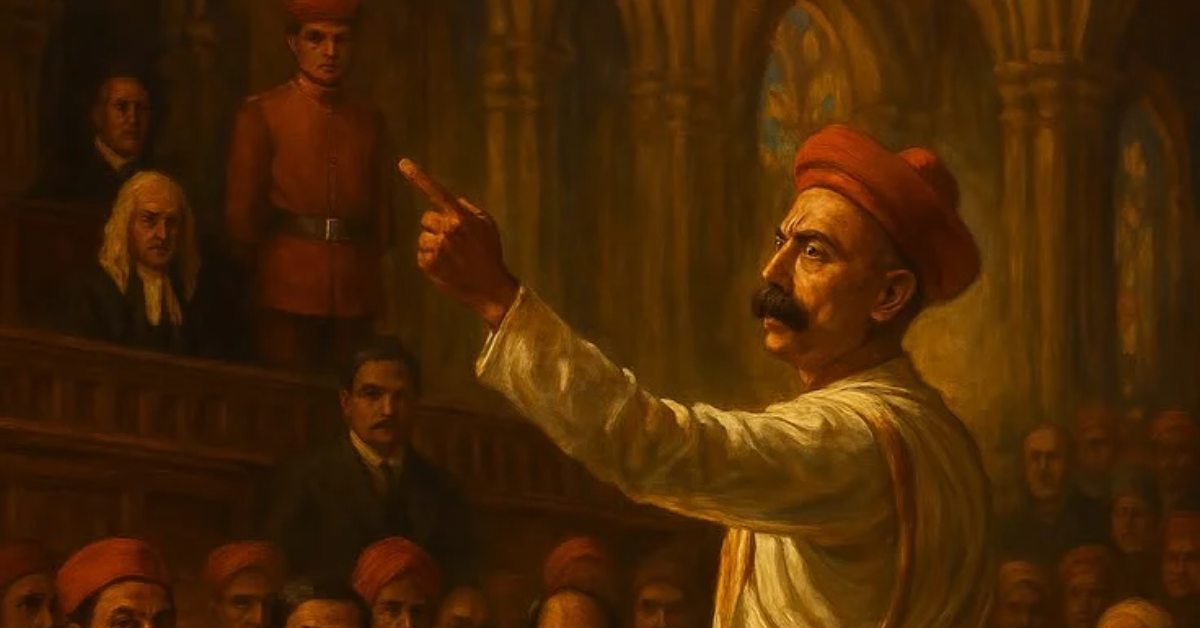
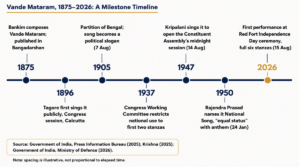
Bankim Chandra Chattopadhyay wrote Vande Mataram in 1875 and published it in his journal, Bangadarshan. The song imagined the nation as a mother, with rivers, harvests, and moonlit nights. It gained popularity during the Swadeshi movement, with students chanting it during protests against the partition of Bengal in 1905. The colonial state responded with repression—bans on chanting in Barisal, fines on Rangpur schoolchildren, and lathi charges in Belgaum—measures that only amplified the song’s resonance.
The later verses invoked the motherland as Durga and Lakshmi, a Shakta idiom that unsettled many Muslim leaders. By the 1930s the Muslim League formally objected, not merely on communal grounds but because the imagery conflicted with a shared national ritual. In 1937 Nehru’s correspondence with Subhas Chandra Bose reveals a leadership grappling with genuine discomfort beneath manufactured outrage, urging Congress to address real grievances rather than placate noise.
Tagore, consulted directly, recommended limiting the national use of Vande Mataram to its first two stanzas. His advice shaped the 1937 resolution, leaving the song’s status ambiguous—revered yet never formally adopted as an anthem. That ambiguity persisted into the Republic, allowing the song to remain a potent symbol without an official office.
Ninety Years of Resistance Defined National Identity
The Swadeshi era turned Vande Mataram into a rallying cry. Freedom fighters carried it to the gallows, and the British crackdown only deepened its association with the independence struggle. In 1907 Bhikaji Cama stitched the words onto a tricolour and raised it over Stuttgart, creating the first Indian flag on foreign soil and projecting the song’s defiance onto the world stage.
Despite its popularity, the song’s full adoption remained contested. During the Constituent Assembly’s Assumption of Power ceremony on 14 August 1947, Sucheta Kripalani sang the first verse, yet the choice of a national anthem lingered. Debates centered on Jana Gana Mana’s perceived Bengali idiom and its proximity to a 1911 tribute to King George V, while Vande Mataram’s religious overtones worried minority representatives.
Nehru argued for Jana Gana Mana on practical grounds—its tune impressed foreign orchestras and military bands, whereas Vande Mataram proved less exportable instrumentally. The compromise that emerged left Jana Gana Mana as the anthem and Vande Mataram with “equal status,” a decision formalized by President Rajendra Prasad’s statement on 24 January 1950.
Red Fort Ceremony Marked Historical Reconciliation
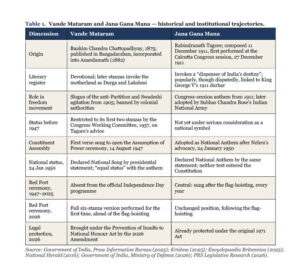
The 2026 Red Fort ceremony broke a 79‑year pattern by placing Vande Mataram at the centre of the Independence Day ritual. For decades the anthem alone occupied that space; the inclusion of Vande Mataram acknowledged its pivotal role in the freedom struggle and its continued relevance in contemporary Bharat.
This act was more than symbolic. It signalled a state‑level recognition that the nation’s cultural tapestry accommodates multiple historic songs, each embodying distinct facets of the anti‑colonial narrative. By playing Vande Mataram alongside Jana Gana Mana, the government affirmed a pluralistic vision of national identity, one that respects both the linguistic‑musical heritage of Tagore and the devotional fervour of Bankim’s verses.
The ceremony thus became a moment of historical reconciliation, illustrating how institutional decisions can evolve to reflect a broader, more inclusive memory of the past.
Bengali Original Influenced Indian Nationalist Movements
Vande Mataram’s Bengali roots gave it a potent regional resonance that helped galvanise the Swadeshi movement in Bengal. Its vivid imagery and emotive language resonated beyond the province, becoming a unifying chant for freedom fighters across the subcontinent.
Tagore’s musical setting amplified its reach. The melody, adaptable to marching bands and public gatherings, forged a sense of collective purpose. The song’s deployment in protests, cultural events, and national ceremonies cemented its status as a rallying point for diverse anti‑colonial forces.
Even after independence, the song’s legacy persisted in cultural memory, influencing contemporary celebrations and political discourse. Its endurance underscores the power of a regional literary work to shape a pan‑Indian nationalist narrative.
Government Approval Ended Long Legal Battles
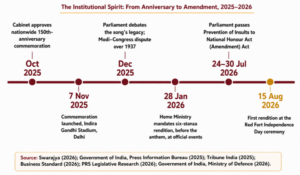
President Rajendra Prasad’s 1950 statement resolved the protracted debate by declaring Jana Gana Mana the national anthem and granting Vande Mataram “equal status.” This presidential pronouncement, rather than a parliamentary vote, cemented the dual‑song arrangement without embedding either in the Constitution.
The decision provided closure to decades of contention, allowing Vande Mataram to occupy a formal, though not exclusive, place in state ceremonies. Its eventual appearance at the Red Fort in 2026 demonstrates how the earlier compromise has matured into a lived practice.
As Bharat continues to negotiate its civilizational continuity, the coexistence of these two songs invites reflection on how historical symbols are re‑interpreted, how collective memory is negotiated, and what future rituals might emerge from this evolving dialogue.
Source: Original reporting